


The origin of democracy
The term ‘democracy’ originates from the Greek words ‘demos’ (‘people’) and ‘krateo’ (‘to rule’ or ‘to govern’), which literally translates as ‘rule by the people’. The first form of democracy emerged in ancient Greece, where important decisions were made directly by citizens in the Greek city-states, which is why it became known as ‘direct democracy’.
Indirect democracy
Over the centuries, democracy has evolved from the pure direct democracy of the Greek city-states into a more indirect form of rule by the people. Today, democracy in most countries means that citizens elect representatives to look after their interests. This has given rise to various forms of democracy, the most fundamental distinction being between a ‘direct’ and an ‘indirect’ democracy.
The people are sovereign
Contemporary democracy is a state ideology in which the people are sovereign, both directly and through representation. Through elections, citizens grant legitimacy to the decisions of their elected representatives, thereby ensuring public support for legislation.
The Trias Politica
A fundamental aspect of contemporary democracy is the principle of the ‘Trias Politica’. According to the French Enlightenment philosopher Montesquieu, the separation of powers is crucial to a well-functioning democracy. Within a state, he identifies three powers:
- Legislative power
- Executive power
- Judicial power.
In an effective democracy, these powers must never be concentrated in the same hands or institution. By dividing these powers among different individuals or bodies, a system of ‘checks and balances’ is created, in which the powers mutually check one another in order to maintain balance.
2. Direct democracy
In a direct democracy, the people decide directly on matters of state. An example of a direct democracy is Swiss democracy, where citizens have a duty to vote on matters of state through binding referendums. Most legislation is drafted, adopted, and implemented on the basis of these referendums. This form of direct democracy most closely resembles the original democracy we know from the ancient Greeks. Outside Switzerland, however, direct democracy in Europe is hardly found in practice.
3. Indirect democracy
An indirect, or ‘representative’, democracy is the most common form of democracy. In this system, the people’s representatives and/or administrators are elected by citizens. The elected representatives thereby obtain the (temporary) mandate to represent the voice of the people.
4. Parliamentary democracy
A variant of indirect democracy is parliamentary democracy. In a parliamentary system, the population elects the parliament, but not the government. There is a relationship of interdependence between parliament and government: only together do they form the legislative power. In most cases, the government proposes bills, but these must be approved by a majority of parliament.
5. Presidential system
The alternative to a parliamentary system is a presidential system. The United States is a classic example of such a presidential democracy. In a presidential democracy, the president is elected through direct elections. The cabinet of the elected president, along with their ministers, is not required to be accountable to parliament.
The term ‘direct’ elections can be a source of confusion. A directly elected parliament or president is not, in fact, a feature of direct democracy, but rather of indirect democracy. Because decisions on matters of state are made by the elected representative(s) and not by the citizens themselves, a directly elected parliament or president also falls under the heading of ‘indirect democracy’.
The Netherlands
The Netherlands is currently an indirect democracy. However, the term democracy does not appear in the Dutch Constitution. Only in Article 50 of the Dutch Constitution is representation of the people mentioned. Article 50 reads: ‘The States General shall represent the entire Dutch people.’ This article forms the constitutional basis for the Netherlands’ representative democracy.
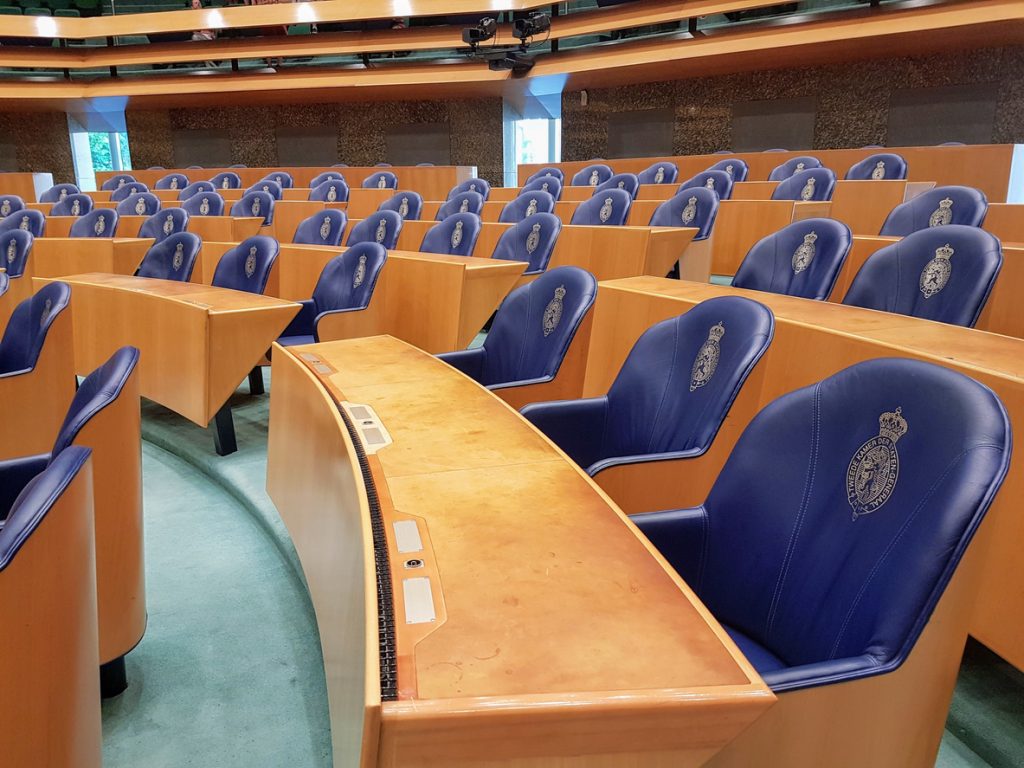
In the Netherlands, the people are represented by the House of Representatives (Second Chamber) and the Senate (First Chamber). The cabinet cannot enact laws without their being approved by both Chambers. This makes the Netherlands a parliamentary democracy. In addition, the Dutch parliamentary system is dualistic. This means that the States General (House of Representatives and Senate) position themselves independently of the government: ministers are not members of the States General. In the United Kingdom, for example, ministers are. In such a case, this is referred to as ‘monism’.
Advisory referendum
Between 2015 and 2018, it was possible in the Netherlands to request an advisory referendum on adopted laws. If at least 300,000 eligible voters submitted such a request, such a referendum would be called. The cabinet was not obliged to honor the outcome of the referendum, but was expected to take it into account in its decision. In this way, a more direct flavor was given to the indirect democracy. However, the Rutte III Cabinet decided to repeal the Advisory Referendum Act, because it felt that the advisory referendum had not lived up to expectations.
House supports constitutional amendment for corrective referendum
Sources: https://www.montesquieu-instituut.nl/ and https://www.eerstekamer.nl/
