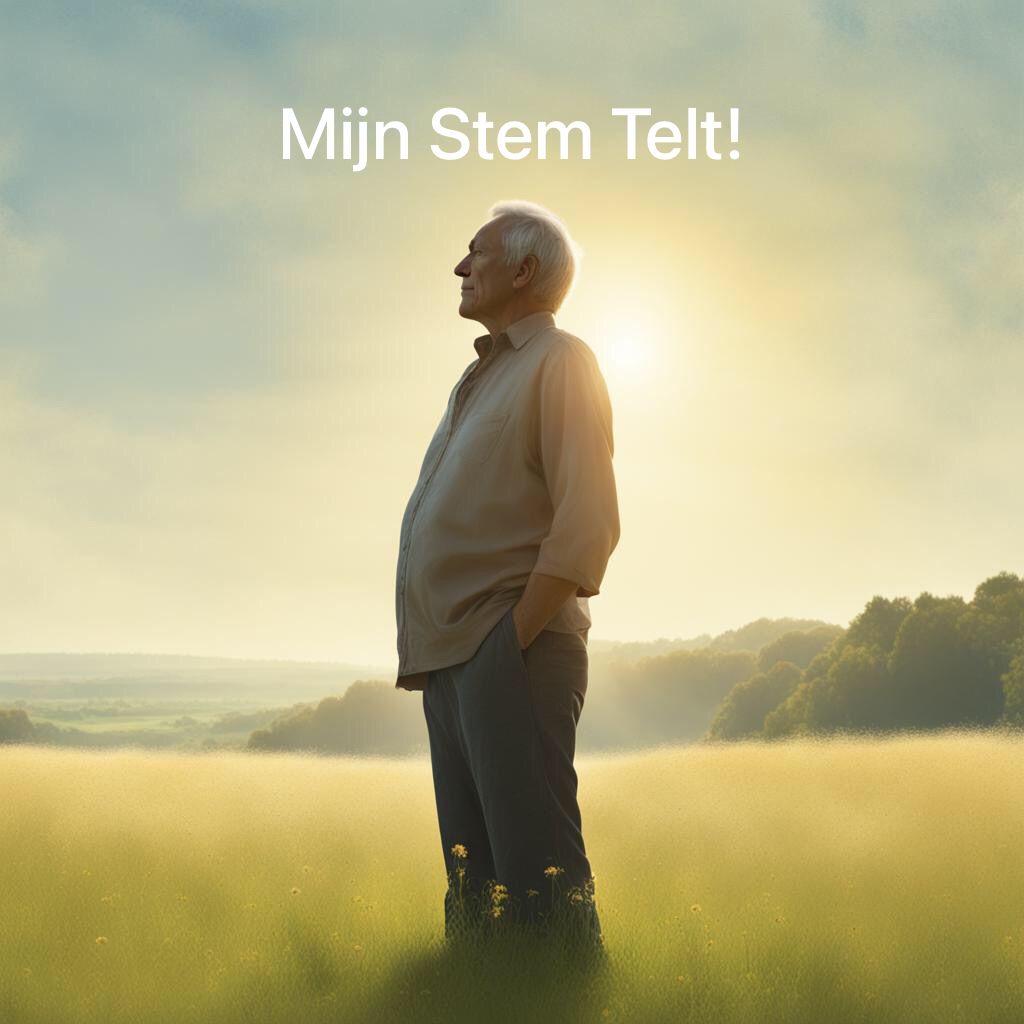



Mijn Stem Telt! The Citizens' Initiative
gives political power back to the citizen
How are we going to do that?
We create a survey in which we ask our members (and eventually every Dutch citizen) what they think about certain issues, positions, upcoming motions, laws, and everything that goes with it.
And you may change your opinion in the survey as often as you like. Because the world changes, your knowledge changes, your situation changes, so of course you’re allowed to change your mind (no hurdles, we promise)
This way we continuously take the pulse of what the majority opinion is on every position and every question, and we will stand firmly behind that majority opinion.
(even when it isn’t our personal opinion)
And if we’ve forgotten to ask about a topic, you can let us know so that we can also find out what the public thinks about it.
Oh, and the results of the survey are of course visible to everyone. That way you can see that ‘Mijn Stem telt! does what we promise!
Changing the political system
We are fighting for a political system change that puts decisive decision-making first, instead of coalition politics. We put your own future in your hands.
After all, isn’t it strange that you vote for a party and its positions, only to find out that once coalitions are formed, your party’s positions suddenly shift in a different direction.
In the current political climate, it has become common to play on people’s fears instead of the challenges we face together. We call that polarising. That doesn’t make our culture friendlier, more social, fairer, or better.
We will dissolve ‘Mijn Stem Telt!‘ as soon as our goal has been achieved. Which makes sense, because once regularly checking the opinion of the people (real democracy) has become established practice, we will no longer be needed.
Become a member of ‘Mijn Stem Telt!‘ And make your voice heard.
Our goal, our vision.
Our goal is a peaceful shift from the current parliamentary system to a democratic, binding citizens’ referendum system.
It isn’t as simple as we make it sound here, because a great deal has to change in the political system, alongside various laws — we have given it a lot of thought. But the steps we currently have in mind to reach our goal will of course be put to you as well. And where necessary, we will adjust here too, to the will of the people.
The point is that nowadays more than 90% of people in our country can share their opinion every single minute. That means politicians can constantly find out what the public wants. (Why aren’t they doing that yet? Well…)
We strive for a system in which citizens are always consulted, on everything. But based on a humanist ethical foundation. And perhaps, therefore, a body that safeguards this foundation. But we will take that step together too, and your opinion will be asked for it, and perhaps we’ll ask you for even more.
How much support is there currently for the binding referendum?
Become a member of Mijn Stem Telt! And think along with us — let’s build the future together. Because as far as we’re concerned, nothing is set in stone.
You’ll then receive invitations to workshops and webinars, but above all we ask you to help build and shape the politics of tomorrow.
Why choose Mijn Stem Telt
Our positions






Your donation helps...
Donating to “Mijn Stem Telt! Het Burgerinitiatief” means you’re supporting the long-term future of a new political movement. We stand for a binding citizens’ referendum. We want to bring power and decision-making authority back to the citizen. Every vote counts with us! To make this happen, we aim to inform as many Dutch people as possible about our vision for the Netherlands. You can contribute to this by making a donation.
Frequently asked questions
Why was Mijn Stem Telt! Het Burgerinitiatief founded?
The Dutch political system – Introduction
Our current political system no longer meets our needs. It’s a remnant of the “pillarised” society (late 19th century-1960), a last vestige that isn’t democratic enough to properly tackle the challenges of this modern era.
Traditional politics is still firmly rooted in our society
Although pillarisation is largely a thing of the past, political parties remain trapped in this old structure. They present an ideological or worldview-based manifesto, which voters vote on. However, once the vote is cast, voters have little influence, and elected politicians can act as they see fit. Voters make their choice based on party manifestos, but this means they can end up disagreeing, in substance, with other points from that same party.
Support for political parties has been particularly low for years
As a result, support for political parties drops sharply per individual manifesto point.
The Dutch political system is creaking at the seams
The Netherlands has over 13 million eligible voters, of whom usually between 2 and 3 million vote for the winning party. In the most recent House of Representatives elections, turnout was 77.7%. That’s over 10 million voters, who could choose between 29 different parties.
The coalition agreement is often the death blow for original positions
It gets even more complex! Politicians have to make concessions while forming a coalition. As a result, the original positions of all the parties at the negotiating table get watered down. What’s more, many laws and rules are laid down in European agreements and treaties. In short, a party’s original positions are barely recognisable by the time they’re actually implemented.
Political decision-making back to the citizens
That’s why Mijn Stem Telt! Het Burgerinitiatief believes that, in the Netherlands, all eligible voters should be able to help decide on important social issues, at local, provincial, national and European level.
Binding referendum
This can be achieved by organising binding referendums on relevant topics, actively involving people in political decision-making.
A stronger democracy through greater citizen influence
This new political party, Mijn Stem Telt! Het Burgerinitiatief, strives for greater influence for citizens, based on equality.
What is a binding citizens' referendum?
A binding citizens’ referendum is a form of direct democracy in which the public is directly involved in decision-making on important issues. In this case, the referendum is binding, meaning the results are legally mandatory and directly influence government policy.
Why the binding citizens' referendum is the key to political renewal?
The current political system in the Netherlands has not been fit for purpose for years. Holding elections every 4 years can still be called democratic. What happens afterwards, however, has nothing to do with that anymore. In order to implement decisions, several political parties have to form a coalition to reach a governing agreement.
From making compromises to a binding referendum
By making compromises and failing to listen properly to citizens, many people no longer recognise the plans in the ideas (manifesto) they thought they had voted for. This has to, and can, change by introducing a binding referendum. This puts power back where it belongs: with the citizen.
What are 11 benefits of a binding referendum?
A binding referendum in Dutch politics can have several benefits, including:
1. Direct citizen involvement
Citizens get a direct opportunity to take part in important decision-making processes, making them feel more involved in politics.
2. Increased legitimacy of decisions
Decisions resulting from a binding referendum carry a higher level of legitimacy, because they are made directly by the people.
3. Strengthening democracy
Implementing a binding referendum strengthens democracy by giving power back to citizens and letting their votes count on important issues.
4. Transparency and openness
Referendums can bring more transparency and openness to the decision-making process, since the public debate and the arguments of all stakeholders, both proponents and opponents, are laid bare.
5. Narrowing the gap between citizens and politicians
Referendums can help narrow the gap between citizens and politicians by enabling direct participation and ensuring the will of the people is represented.
6. Faster decision-making
In some cases, a referendum can enable faster decision-making than traditional political processes, especially for controversial issues on which politicians struggle to reach agreement.
7. Protection of minorities
A binding referendum can serve as a protective mechanism for minorities, since it prevents the majority from making decisions that could be harmful to minority interests.
8. Innovation in policymaking
Referendums can be a spur for innovation in policymaking, as they bring in new ideas and perspectives from the public that might otherwise be overlooked in traditional political processes.
9. Increased political participation
Holding referendums can boost political participation by encouraging more people to take part in the political process and cast their vote on important issues.
10. Strengthening trust in government
By giving citizens direct influence over important decisions, a binding referendum can strengthen trust in government and increase people’s sense of civic satisfaction.
11. No more compromises in governing parties’ coalition agreements
In the Netherlands you always need several parties to govern. This always results in a coalition agreement full of compromises between the governing parties. Sticking plasters are often applied instead of problems actually being solved. Introducing a binding referendum can largely change that.
How does a binding referendum broadly work?
Mijn Stem Telt! Het Burgerinitiatief believes that the binding referendum is the most democratic system possible. It is an absolute answer to the traditional world of power and money.
Here are a few of the broad outlines:
- A binding referendum can be requested on any topic.
- It’s also possible to quickly bring a new topic to a vote. The outcomes will fairly quickly become self-regulating.
- Voting can be done digitally from your own location. Where necessary, voting locations will be designated.
- Information on the points and reasoning of both proponents and opponents will be released in good time for study.
- Referendums are prepared by recognised institutions such as the Centraal Planbureau (Netherlands Bureau for Economic Policy Analysis) and the Social and Economic Council.
- The outcome is shown as a percentage, but the results are also explained in detail and broken down by element where needed.
- A referendum doesn’t have to take place in a single day. By organising it digitally, for example a whole week could be set aside for it.
- Mijn Stem Telt! stands for the binding referendum at every level of government, such as: municipal government/mayor, provincial council/King’s Commissioner, regional water authority, and of course national and European level.
Why does Mijn Stem Telt! Het Burgerinitiatief use humanist ethics?
Mijn Stem Telt! Het Burgerinitiatief, grounded in humanist ethics, puts people and human dignity first. We look out for the weaker members of our society, because sooner or later everyone belongs to that group.
Humanist ethics
Humanist ethics is an ethical approach central to humanism, a philosophical and life-stance movement that holds human dignity, freedom and responsibility in high regard. Humanist ethics focuses on developing moral principles and values based on human reason, experience and empathy, rather than on religious doctrine or absolute authority.
People first
In humanist ethics, the wellbeing of individuals and society is central. It strives for an ethical framework based on human autonomy, rationality and compassion. Humanists believe that ethical norms and values arise from human experiences, relationships and reflection.
Important aspects of humanist ethics can include:
Human dignity: The idea that every individual possesses intrinsic worth and dignity, regardless of external factors such as religion, background or social status.
Freedom and autonomy: Emphasising the importance of individual freedom and autonomy in making choices, as long as those choices don’t harm others.
Empathy and compassion: Promoting empathy and compassion as a basis for moral action, being mindful of the needs and interests of others.
Reasonableness and rationality: Encouraging reasoned thinking and rationality as tools for understanding and applying ethical principles.
Humanism itself is a broad movement with various interpretations, so there can be variations in how humanist ethics is applied. Important humanist thinkers, such as Erasmus, Desiderius Erasmus, and humanist organisations, such as the Humanistisch Verbond (Dutch Humanist Association), have contributed to the development and spread of humanist ethics.
Sources:
- American Humanist Association. (n.d.). “What is Humanism?” Retrieved 28 January 2024, from https://americanhumanist.org/what-is-humanism/
- Shermer, M. (2015). “The Moral Arc: How Science and Reason Lead Humanity Toward Truth, Justice, and Freedom.” Henry Holt and Co.
- Humanistisch Verbond. (n.d.). “About the Humanistisch Verbond.” Retrieved 28 January 2024, from https://humanistischverbond.nl/over-ons/
What is the future dream of Mijn Stem Telt! Het Burgerinitiatief?
The primary goal of Mijn Stem Telt! Het Burgerinitiatief is the full introduction of the binding citizens’ referendum, in place of the current system of indirect parliamentary democracy.
At the moment, trust in politics is particularly low. Major problems are barely solved, and after elections citizens have no influence whatsoever. Governing parties draw up a coalition agreement in which the original ideas from their manifestos are barely recognisable to voters anymore. As a result, citizens no longer recognise themselves in political decision-making. This can and must change! Mijn Stem Telt! advocates a new political system with binding citizens’ referendums, replacing the current system in which political parties call the shots. In the new system, political parties would at most play the role of proposing referendum topics.
In short, once our biggest goal — introducing a political system based on binding citizens’ referendums — has been achieved, Mijn Stem Telt! will dissolve itself.
Does Mijn Stem Telt! have any other positions besides introducing the binding referendum?
Yes, Mijn Stem Telt! does have other positions. Introducing a system based on binding citizens’ referendums takes time. It means the Constitution has to be amended. That requires 2 votes across 2 successive cabinets, in both the House of Representatives and the Senate. Until then, Mijn Stem Telt! Het Burgerinitiatief takes part in the current political system.
1. Direct democracy
We are politics! Every citizen in the Netherlands. Current political parties don’t handle the voice of the people well. That’s why we want to give power back to the citizen. Mijn Stem Telt! is therefore in favour of:
- an elected mayor
- a Senate that is not elected by the Provincial Councils
- an elected prime minister
- a monarch with no influence over the political process
2. Administrative feasibility
Many government bodies are struggling organisationally. The COA (Central Agency for the Reception of Asylum Seekers) is creaking under the asylum crisis, but the Tax Authority and the CBR (vehicle licensing agency), for example, also regularly run up against the limits of what’s possible. In the area of taxation there are too many exceptions. If certain measures hit particular groups of people especially hard, those people then have to be compensated again, and yet another scheme is created. The result is that we’re saddled with a complicated tax system, both for citizens and for tax authority staff. Simplifying the tax system is therefore urgently needed, according to Mijn Stem Telt! We recommend carrying out a thorough review of all these kinds of government bodies to analyse where the pain points are and how they can be resolved. This should also include an in-depth look at options such as replacing the entire benefits system with a basic income. Newly proposed legislation should be tested for feasibility with the tax authority, and the resulting conclusions should be debated in the House of Representatives.
3. Education
In recent years our teachers have received more money for the wonderful profession they practise. Good education is the engine of our economy, so the importance of good education is self-evident.
However, the world is changing fast, and it seems education isn’t keeping up sufficiently. Reading, language and maths are important and deserve a lot of attention. Personal and general development are important. However, technology and engineering play an ever-larger role in our lives, and that isn’t reflected in education. We therefore advocate extra technology lessons and teaching programming from an ever-younger age. Too much time is still spent learning facts that are, firstly, easy to look up, and secondly, quickly forgotten again. We want to get the Netherlands ready for the future, and that starts with good education. That’s why we advocate a thorough investigation into our education system and how we connect it to what society and future developments actually need.
4. Europe
Europe is perhaps the most undemocratic institution there is. Turnout at European elections is often barely 50%. People aren’t interested, because they think they have hardly any influence. That’s why Mijn Stem Telt! takes part in the European elections — to put our idea, the introduction of a binding referendum, on the map at European level too. We readily admit that this is difficult, but things could hardly get much worse than they already are. The Netherlands has for years been one of the biggest net contributors. Few people know exactly what the EU gives us in return, which is strange. Greater transparency in decision-making processes would certainly have a very positive impact in Europe too. Show much more clearly what Europe does and what it delivers for us and our neighbouring countries. Mijn Stem Telt! is pro-Europe; there are, however, several things that aren’t going well yet and need improvement. The EU shouldn’t try to have a say in everything, but it can play an important role in areas such as the economy, security, climate and the environment, and asylum. It should also be allowed to be stricter on wasting money — so not shuttling monthly between Brussels and Strasbourg.
Finally, if our dream really comes true with the full introduction of a system of binding citizens’ referendums, then all our positions go in the bin, and it’s up to the citizen.
Why the white-picket-fence dream is further out of reach than ever for many people?
For many people, voting for the political party that’s ‘right’ for them is quite a challenge. There are many parties, each with an extensive manifesto full of positions. Which party suits you? Many people are unsure, because they often don’t agree 100% with a party’s manifesto. In 9 out of 10 cases, people fill in a voting-advice tool and arrive at a choice that way.
A sad observation
For many people, a nice house, an enjoyable job, and a healthy, safe and pleasant life is the ideal. After years of political failure, and major problems barely being solved, if at all, it’s fair to say that current politics cannot make this happen for a large group of people.
The sad facts
- The housing market is completely stuck, meaning many people can’t manage to find a suitable home.
- There is no vision for the future of how we’re going to earn our money. AI and automation are going to wipe out many jobs, which will create redistribution challenges.
- Climate problems are not being tackled adequately. In the Netherlands, 10,000 people a year die prematurely due to poor air quality.
- Wars and military missions. There is a war on our continent, which we are, in effect, simply taking part in.
- Our social security system is under great pressure from the influx of migrants and asylum seekers. That influx will grow much larger still if the climate in Africa becomes even more extreme.
Who is responsible? More importantly, how do we fix it?
Our current political system originated in the 19th century, when the world was still a good deal smaller and easier to make sense of. The world, however, has become bigger and more complex. This has also created bigger, more complex problems.
Time and again, current political parties have failed to solve our problems and to make the white-picket-fence ideal achievable for large groups of people.
Our politicians surely mean well, but they have to work within a political system that no longer works properly.
Because a coalition is needed to govern, every party has to make concessions. This often leads to ‘sticking plasters’ rather than good solutions that everyone can get behind. A lot of time is also lost to party politics during the coalition-formation process.
A political system of binding referendums
Voting for Mijn Stem Telt! Het Burgerinitiatief is therefore more important than you think. We advocate a systemic shift towards a system of full direct democracy with binding citizens’ referendums. We firmly believe that citizens know very well what’s good for them. By sidelining the political parties and opting for fully transparent referendums, we move towards a situation with better-quality decisions that have sufficient public support.
Doing nothing, or just muddling through, is simply not an option!
Get in touch via info@nl.mijnstemtelt-network.local, and we’ll explain it to you in person.
Become a member
Are you also in favour of more direct democracy? Support us in introducing a fully binding citizens’ referendum system, and become a member of ‘The Friends of Mijn Stem Telt’.